B-Grade vs A-Grade Solar Panels: Is the Discount Worth It?
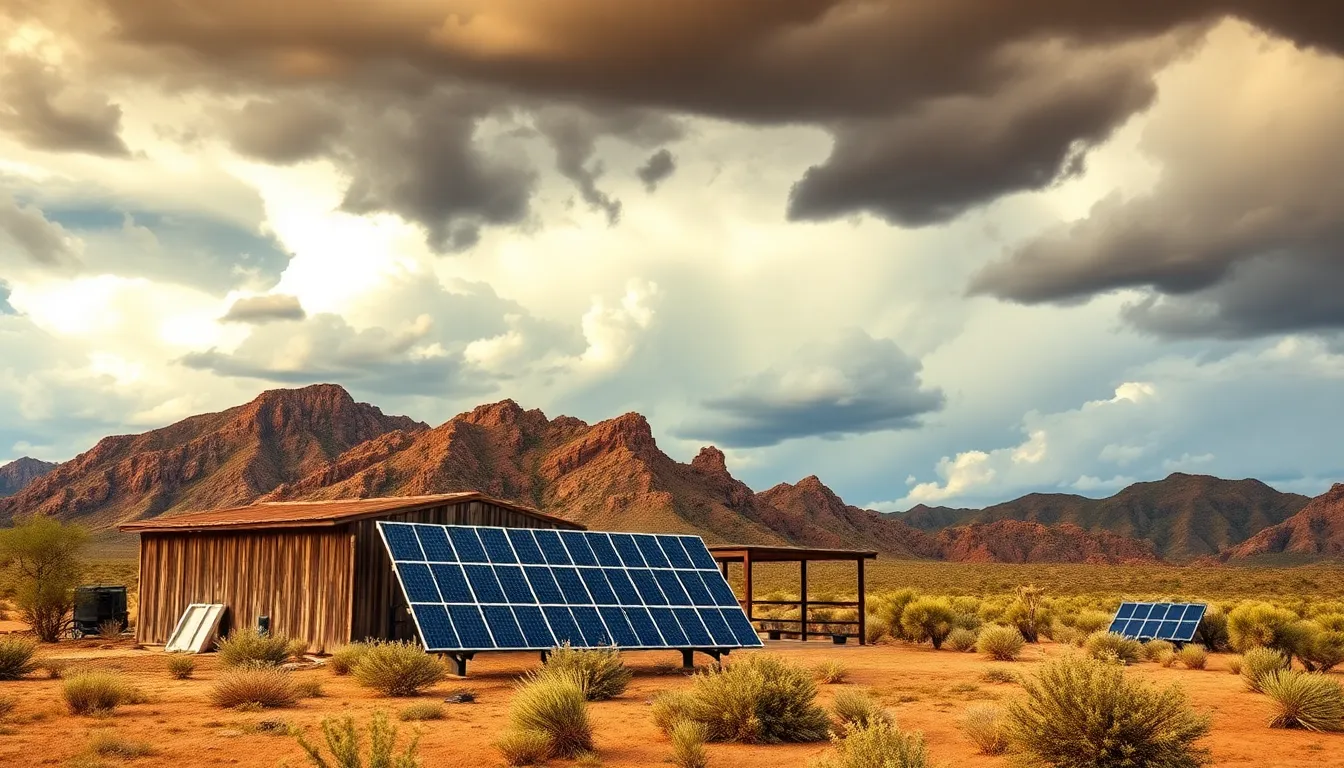
What the A/B grade distinction actually describes, why B-grade panels cost less, and when the cosmetic-versus-electrical trade-off is worth taking.
Going off-grid in Cochise County means making dozens of equipment decisions, and solar panel grade is one that catches a lot of landowners off guard. You're shopping online, you see a B-grade panel at 30 percent less than the A-grade equivalent, and the question lands hard: Can I save that money without tanking my system?
The short answer is context-dependent. For Cochise County's high-insolation environment and the specific demands of off-grid living, the calculus is different than it would be in a cloudier region or for a grid-tied installation where you can absorb performance variance. This post walks through what B-grade actually means, why it matters in our desert climate, and what you should actually buy for a reliable off-grid setup in Sulfur Springs Valley.
What A-Grade and B-Grade Actually Mean
Panel grading isn't a formal standard—there's no NREL or IEC specification that says "this is B-grade." Instead, manufacturers and resellers use it as a catch-all for panels that don't meet cosmetic or minor performance specs for the primary market.
A-grade panels are the standard product: they meet manufacturer specifications for output (within ±3 percent of rated wattage), have no visible defects, and come with full warranty coverage. If you buy a 400-watt A-grade panel rated for 400W, you're getting something that tests between 388W and 412W under standard test conditions.
B-grade panels typically fall into one of these buckets:
- Cosmetic defects: scratches, discoloration, or minor frame damage that doesn't affect electrical performance.
- Out-of-spec output: panels that test at 95–98 percent of rated wattage instead of 100–103 percent.
- Warranty limitations: shorter coverage period (5 years instead of 25) or exclusion of degradation warranties.
- Overstock or returned inventory: panels that are electrically sound but don't fit the primary distribution channel.
The key distinction: B-grade usually means cosmetic or minor electrical variance, not structural failure. A B-grade 400W panel might output 380–395W under test conditions. It won't spontaneously fail or degrade faster than an A-grade panel of the same model.
But here's where Cochise County context matters. Our 300-plus sunny days per year and seven to eight peak sun hours during peak months mean you're running your panels hard. Every watt counts in an off-grid system. A 5 percent output loss isn't invisible—it compounds across a 25-year lifespan.
Why Off-Grid Systems Are Less Forgiving Than Grid-Tied
If you're grid-tied in Willcox and your panels underperform by 5 percent, you draw slightly more from the grid on cloudy days. The utility absorbs the variance. You don't notice.
Off-grid is different. Your battery bank is your buffer. If your panels are rated for 5 kWh per day but only deliver 4.75 kWh because they're B-grade, your battery charges slower. On a marginal solar day (rare here, but they happen during monsoon season), you might not reach full charge. Over weeks, you're cycling your battery more deeply, which reduces its lifespan and increases your risk of blackouts.
This is especially critical in Sulfur Springs Valley because of our monsoon pattern. June through September, we get afternoon thunderstorms that can block sun for hours. If your system is already margin-thin, you're vulnerable. A-grade panels give you the buffer you need to weather those seasonal dips.
Additionally, off-grid systems require accurate pre-design calculations. When you're sizing a battery bank, you're working backward from expected panel output. If you assume 5 kW of panels will deliver 25 kWh per day and they only deliver 23.75 kWh, your battery is undersized. That's a problem that doesn't reveal itself until you're living with it.
The Cost-Benefit Math for Cochise County
Let's work through a real scenario. You're planning a 10 kW off-grid solar array for a property near Sulfur Springs. Current pricing (early 2026):
- A-grade 400W panels: ~$120–140 per panel = $3,000–3,500 for 10 panels
- B-grade 400W panels (same model): ~$80–100 per panel = $2,000–2,500 for 10 panels
Savings: $1,000–1,500 on the panel cost alone.
Now add the rest of the system: - Inverter/charger: $2,000–4,000 - Battery bank (48V lithium): $8,000–15,000 - Wiring, breakers, disconnect, monitoring: $1,500–2,500 - Installation labor: $2,000–3,500
Total system cost: $16,500–28,500
That $1,000–1,500 panel savings is 5–9 percent of the total. But here's the catch: if those B-grade panels underperform, you're not just losing the savings—you're potentially undersizing your battery bank or needing to add panels later.
If you discover after six months that your 10 kW array is only delivering 9.5 kW, you have two options: 1. Add another 500W of panels ($600–700 + labor). 2. Reduce your daily load or accept shallower charge cycles on the battery.
Option 1 costs you the savings plus installation. Option 2 costs you quality of life or battery longevity.
For Cochise County off-grid systems, A-grade is usually the smarter buy. The marginal cost difference is small relative to the total system, and the reliability gain is real.
When B-Grade Actually Makes Sense
That said, B-grade isn't always wrong. Here are scenarios where it can work:
1. You have design margin built in. If you're oversizing your array by 20–30 percent intentionally (to account for degradation, shading, or seasonal variation), losing 5 percent to B-grade is absorbed. You still hit your target output.
2. You're buying cosmetic-defect panels, not out-of-spec panels. If the B-grade label is purely about a scratched frame or discoloration, and the electrical specs are identical, the risk is minimal. You need to verify this in writing before purchase.
3. You have experience troubleshooting off-grid systems. If you've sized systems before and you understand how to adjust for underperformance, B-grade is less risky. You're not guessing.
4. You're buying from a reputable local supplier with return/warranty options. Ordering B-grade panels from Alibaba with no recourse is different than buying them from a regional distributor who will stand behind them if they underperform.
For a first-time off-grid build in Sulfur Springs Valley, none of these conditions usually apply. You're buying from online marketplaces, you're doing the design yourself (or with limited help), and you're not oversizing. In that context, B-grade is a false economy.
The Warranty and Longevity Question
Here's another layer: warranty coverage. A-grade panels typically come with 25-year output guarantees (usually 80 percent minimum at year 25) and 10–12 year product warranties. B-grade panels often have 5–10 year coverage or exclusions on degradation warranties.
In Cochise County's intense sun, panel degradation is real. Quality panels degrade at 0.5–0.7 percent per year. Over 25 years, a 400W panel is down to 320–340W. If you're starting with a B-grade panel at 380W, you're down to 300–320W by year 25. That's a meaningful loss.
More importantly, if something goes wrong—a junction box failure, micro-cracks from thermal cycling (which happens in our 40-degree temperature swings between day and night)—you want warranty coverage. B-grade panels often don't have it.
What to Actually Specify for Your Cochise County System
If you're building off-grid here, here's what I recommend:
- Specify A-grade panels from a tier-1 manufacturer. Sunpower, Canadian Solar, Jinko, REC—brands with proven track records and accessible warranty support in the US.
- Get written specs on output tolerance. Don't assume; verify that the panels test within ±3 percent of rated wattage.
- Confirm warranty coverage in writing. 25-year output guarantee, 10+ year product warranty, no exclusions for degradation.
- Oversize your array by 15–20 percent. This gives you buffer for seasonal variation, shading, and long-term degradation. It costs less than undersizing and needing to add panels later.
- Buy from a supplier who services the area. If you're in Sulfur Springs Valley or Cochise County, work with a local installer who can troubleshoot and warranty their work. Online-only suppliers don't stand behind their products.
The $1,000 you save on B-grade panels isn't worth the risk of a system that underperforms for 25 years.
The Bottom Line for Off-Grid Cochise County
B-grade panels are a legitimate product category, and in some contexts—grid-tied systems, oversized arrays, experienced DIYers—they're a reasonable choice. But for off-grid living in Sulfur Springs Valley, where you're designing a system to be self-sufficient and you're living with the consequences of underperformance every day, A-grade is the right call.
Our solar resource is exceptional. Our climate is stable. What we don't have is a grid to bail us out if our panels underdeliver. Spend the extra $1,000–1,500 on A-grade panels, design your system with margin, and you'll have reliable power for decades.
If you're sizing an off-grid solar system for your Cochise County property and you're weighing these decisions, Sulfur Springs Land Management can help you design a system that's right-sized for our conditions and backed by equipment you can count on. Contact us to assess your property and develop a solar plan that accounts for Sulfur Springs Valley's unique climate and your actual power needs.
Gear for this job
Affiliate links — we may earn a commission from purchases at no extra cost to you. We only list gear we would actually put on a job.
- Victron SmartSolar MPPT 100/50 Charge Controller — MPPT recovers meaningful yield over PWM on a cold, bright morning.
- Victron BMV-712 Smart Battery Monitor with 500A Shunt — A shunt-based monitor is the only honest state-of-charge reading.
Ready to Develop Your Land?
Sulfur Springs Land Management specializes in land clearing, grading, solar system consultation, and comprehensive off-grid property development. Let's turn your land into your dream off-grid property.
Contact SSLM TodayMore from the Blog
Getting Power to Rural Land: The Estimate Is Not a Price
SSVEC can bill for unanticipated costs up to six months after the work, and obtaining the easements is your job. What a line extension involves.
Rural LivingSplitting a Parcel: The County Will Record a Bad Split
A minor land division permit does not split your land — the deed does. And a split with no legal access can still be recorded if the deeds say so.
Rural LivingRunning a Business From Rural Land: The 25% Rule
Cochise County caps a home occupation at 25% of the residence floor area — even in a detached shop — and prohibits outdoor storage entirely.
Rural LivingSecond Dwellings: What Cochise County Allows on One Parcel
An ADU needs planning approval before any building permit, the owner must live on site, and an RV never qualifies. Park models do, with conditions.
Rural LivingWhat You Can Build Without a Permit in Cochise County
A 200 sq ft shed is exempt until you run power to it. The county's exemption list, the $1,000 threshold, and the fence rule that catches people.
Rural LivingFloodplain Rules Reach Further Than the Flood Map
A floodplain use permit covers grading and fencing, not just building — and watercourse setbacks of 50 to 300 feet apply to every structure.
Rural LivingThe Owner-Builder Option That Costs You the Certificate
Cochise County's no-inspection owner-builder path is cheaper and never gets a Certificate of Occupancy. What that means for lenders, insurers and buyers.
Rural LivingYou Cannot Camp on Your Own Vacant Land in Cochise County
The county's answer is a flat no — camping needs an established use on the parcel. What a temporary use permit actually allows while you build.
Rural LivingOpen Range: In Arizona You Fence Cattle Out, Not In
Arizona law bars recovery for livestock trespass unless your land sits inside a statutory lawful fence — and the statute specifies the wire spacing.
Rural LivingRural Internet: The FCC Map Shows Claims, Not Service
The national broadband map reports what providers say they offer at your parcel. How to check it, and the two challenges you can file when it is wrong.
Rural LivingDefensible Space in Cochise County Starts at the Driveway
Arizona's home ignition zones run 0-5, 5-30 and 30-100 feet. But an engine needs 12 feet of width and 15 of clearance to reach you in the first place.
Rural LivingA Composting Toilet Does Not Get You Out of a Septic System
Arizona excludes the kitchen sink from gray water, so a composting toilet still needs septic. The Type 4 permit, percolation testing and the reserve area.
Rural LivingOwning Arizona Land You Cannot Legally Reach
A dirt track to your parcel is not legal access. What Arizona's private way of necessity actually is, where easements are recorded, and what to check first.
IndustrySulfur Springs Valley: Two Water Districts, Not One
The valley is not one groundwater basin but two — Willcox in the north, Douglas in the south — with different rules. What every landowner should know.
IndustryHauled Water vs Drilling a Well: The Real Numbers
What a well really costs at 200-350 ft static water level in Sulfur Springs Valley, what hauled water costs per year, and where the break-even sits.
Rural LivingOff-Grid Solar in Winter: Sizing for Cochise County's Worst Days
Cochise County winter drops you to 4-5 peak sun hours. How to size batteries, autonomy days, inverters and charge controllers for the worst week.
Rural LivingGoat Kids Hide: The Chihuahua Rule for Off-Grid Livestock
Newborn goat kids hide by instinct and vanish on cleared desert ground. A simple sizing rule for clearing that keeps them findable.
Land PreparationOff-Grid Site Prep Checklist: Pad, Access, Drainage, Utilities
A phased checklist for turning raw Cochise County land into a buildable site: survey, building pad, access road, drainage, utilities and septic.
Off-Grid LivingOff-Grid Solar in Arizona: How Many Panels Do You Need?
How many panels an off-grid Arizona property actually needs, what a full system costs in 2026, and the three tiers most Cochise County builds fall into.
Land ClearingLand Clearing in Cochise County: What to Know Before You Start
What land clearing costs in Cochise County, what you may and may not remove under Arizona rules, and which equipment suits mesquite and creosote.
Off-Grid LivingComplete Guide to Off-Grid Water Systems in Rural Arizona
Wells, hauled water, storage and pressure systems for a rural Cochise County property — how the pieces fit and what each one demands of you.